
Project Background
A research team was investigating potential interactions between two candidate proteins involved in a signaling pathway.
Based on published data, the interaction was expected to be detectable using Co-immunoprecipitation (Co-IP).
However, after multiple attempts, no clear interaction signal was observed.
Challenge
Despite following standard protocols, the team encountered:
- No detectable interaction bands after repeated Co-IP experiments
- High variability across replicates
- Uncertainty whether the interaction truly existed
Further analysis suggested that the interaction might be:
- Weak or transient
- Dependent on cellular context
- Sensitive to lysis and washing conditions
Making it difficult to capture using Co-IP alone
Why Co-IP May Miss Interactions
Co-IP is designed to detect:
- Stable protein complexes
- High-affinity interactions
- Binding resistant to washing
However, it has inherent limitations:
- Weak interactions may be lost during washing
- Cellular context is disrupted after lysis
- Signal may fall below detection threshold
Co-IP vs Y2H: Detection Mechanisms
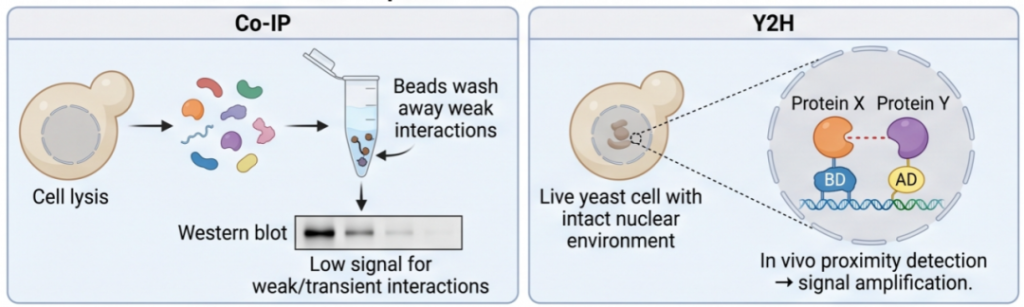
What this shows:
Co-IP detects stable interactions after cell lysis, while Y2H enables in vivo proximity-based detection with signal amplification, allowing detection of weak or transient interactions.
Method Selection Comparison
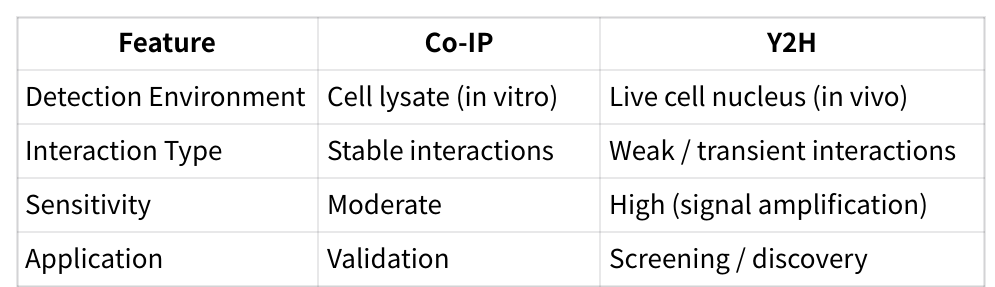
This comparison highlights why Co-IP alone may not be sufficient in early-stage interaction discovery.
Our Strategy
We redesigned the experimental approach by integrating Yeast Two-Hybrid (Y2H) for early interaction screening.
Step 1 — Interaction Screening Using Y2H
- Constructed bait and prey vectors
- Performed controlled screening
- Identified candidate interacting proteins
Enabled detection of interactions that do not survive Co-IP conditions
Step 2 — Validation & Confirmation
To ensure biological relevance, we performed:
- Recapitulation assays to confirm reproducibility
- Orthogonal validation using Co-IP / pull-down
Building a multi-layer evidence framework
Y2H Principle (Molecular Interaction Mechanism)
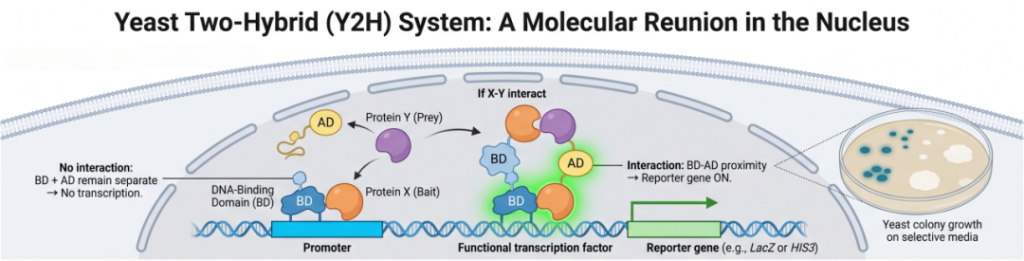
What this shows: Protein interaction brings transcription domains together, activating reporter gene expression and amplifying weak interaction signals.
Workflow: From Screening to Validation

What this shows: A structured workflow from discovery (Y2H) to validation (Co-IP / pull-down), ensuring both sensitivity and biological relevance.
Results
This combined strategy enabled:
- Identification of candidate interacting proteins
- Detection of previously undetectable interaction signals
- Improved confidence through independent validation
The interaction was successfully confirmed through complementary methods
Key Insight
Co-IP is effective for validating stable interactions, but may fail to detect weak or transient ones. Y2H expands detection sensitivity. Combined workflows improve both discovery and reliability.
Optional: Extended Methods (When Needed)
Extended Y2H-Based Systems
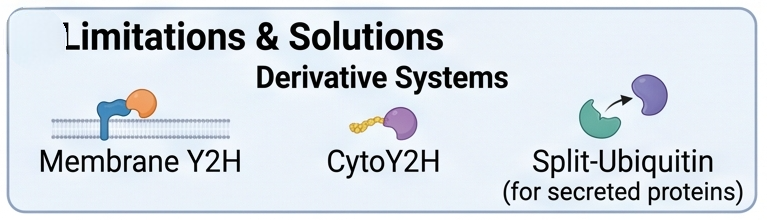
What this shows: Extended Y2H systems allow detection of interactions in membrane, cytoplasmic, or specialized biological contexts.
How We Support Similar Projects
We provide end-to-end support for protein interaction studies:
- Y2H screening (discovery)
- Co-IP / pull-down validation
- Study design based on protein characteristics
Call to Action
Struggling to detect protein interactions using standard methods? We can help redesign your workflow to improve detection and validation efficiency.