
Hyperuricemia (HUA) research has expanded far beyond gout alone. Elevated uric acid levels are now closely associated with chronic kidney disease, metabolic dysfunction, cardiovascular complications, and systemic inflammation.
As interest in urate-lowering therapeutics and metabolic disease research continues to grow, establishing stable and translationally relevant animal models has become increasingly important in preclinical studies.
However, many rodent hyperuricemia studies still encounter:
- Unstable serum uric acid elevation
- High inter-animal variability
- Excessive mortality
- Poor reproducibility in pharmacology outcomes
In many cases, the issue is not experimental execution itself, but rather biological mismatch between the selected model system and the intended research objective.
Why Rodent Hyperuricemia Models Are Fundamentally Challenging
Unlike humans and primates, rodents naturally express uricase, an enzyme that rapidly converts uric acid into the highly soluble metabolite allantoin.
As a result, mice and rats are naturally resistant to sustained hyperuricemia.
This biological difference explains why simple uric acid administration often fails to produce stable serum uric acid elevation in rodent systems.
For this reason, potassium oxonate‒mediated uricase inhibition remains one of the most commonly used strategies for acute hyperuricemia model establishment.
Different Models Address Different Research Questions
There is no universal hyperuricemia model suitable for every study objective. Different systems reproduce distinct aspects of uric acid metabolism, renal injury, inflammatory signaling, and metabolic dysfunction.
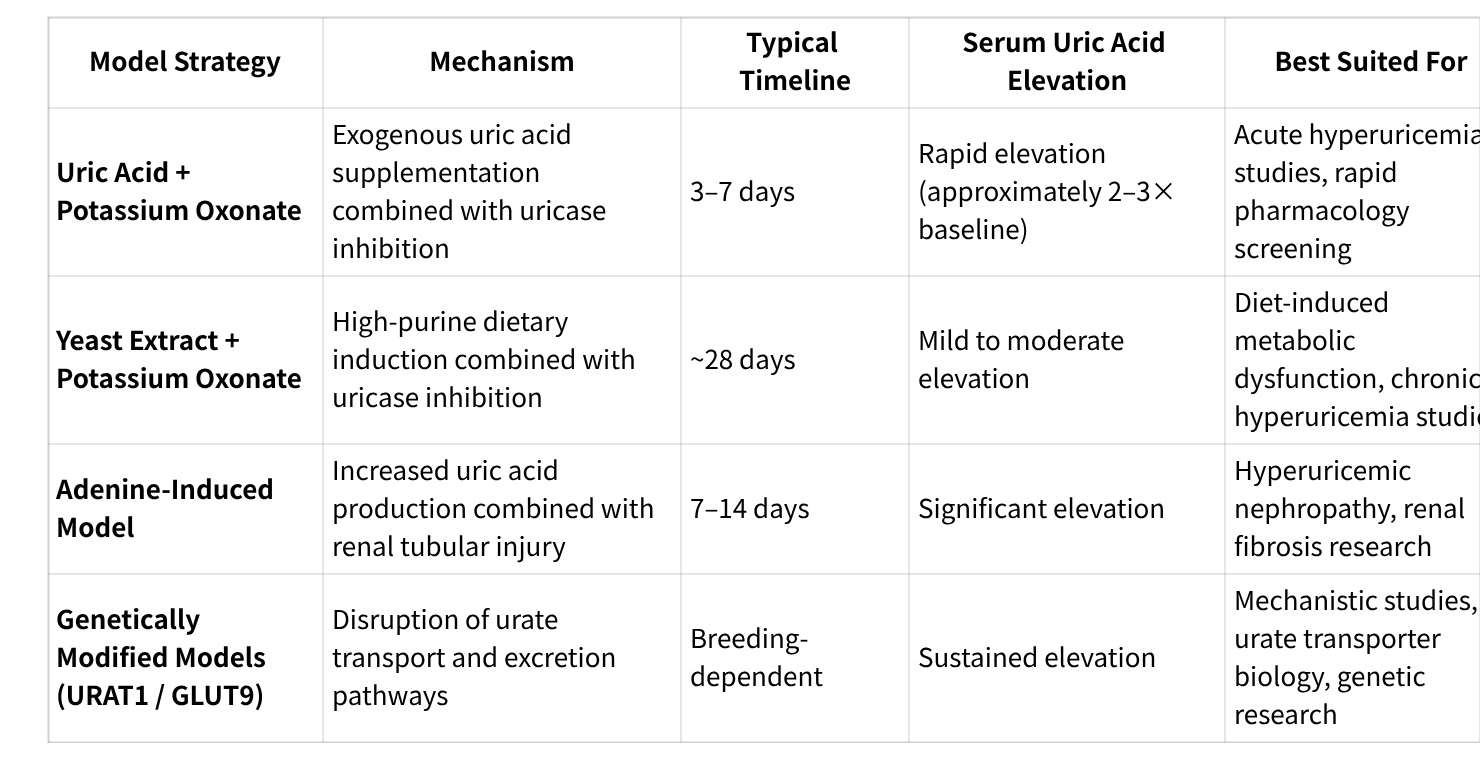
Acute Hyperuricemia Systems
Uric acid combined with uricase inhibition is commonly used for:
- Rapid pharmacology screening
- Acute serum uric acid elevation
- Early-stage efficacy evaluation
These systems are efficient and relatively reproducible when properly standardized, but primarily reflect short-term uric acid accumulation rather than chronic metabolic disease progression.
As a result, they are generally better suited for early screening workflows than for long-term translational studies.
Diet-Associated Metabolic Models
Diet-induced systems, including yeast extract‒associated models, are more commonly used when the study objective involves:
- Chronic metabolic dysfunction
- Diet-associated hyperuricemia
- Lipid and glucose metabolism abnormalities
Compared with acute induction systems, these models may better reproduce long-term metabolic stress, although serum uric acid elevation is often more moderate and experimentally variable.
Renal Injury‒Associated Hyperuricemia Models
Adenine-associated systems are widely used in studies involving:
- Hyperuricemic nephropathy
- Renal fibrosis
- Combined urate-lowering and renoprotective evaluation
However, because these systems introduce substantial renal injury, interpretation of pharmacology outcomes requires careful consideration of nephrotoxicity-related confounding effects.
In many cases, renal pathology rather than serum uric acid alone becomes the dominant disease driver.
Transporter & Genetic Models
Genetic systems targeting urate transporters such as URAT1 or GLUT9 are increasingly used in:
- Mechanistic uric acid metabolism studies
- Transporter biology research
- Long-term translational investigations
Compared with conventional induction systems, these models provide stronger mechanistic relevance but often involve greater complexity in colony management, phenotype stability, and experimental timelines.
Translational Considerations in Hyperuricemia Research
One of the most common causes of inconsistency in preclinical hyperuricemia studies is misalignment between the disease model and the therapeutic objective.
For example:
- Acute hyperuricemia systems may overestimate short-term urate-lowering efficacy.
- Diet-induced models may better reproduce chronic metabolic complications.
- Renal injury models may introduce confounding pathology that affects drug interpretation.
- Genetic transporter models may provide stronger mechanistic relevance but lower experimental throughput.
Model selection should therefore consider not only serum uric acid elevation, but also:
- Disease duration
- Metabolic background
- Renal involvement
- Inflammatory signaling
- Intended translational context
Validation Strategy Matters
Reliable hyperuricemia studies require more than elevated serum uric acid alone. Integrated endpoint strategies commonly include:
- Serum uric acid quantification
- Renal function markers
- Histopathological assessment
- Fibrosis evaluation
- Xanthine oxidase (XOD) activity analysis
- Inflammatory biomarker profiling
Because hyperuricemia-associated pathology involves both metabolic and inflammatory mechanisms, multi-dimensional evaluation is often essential for accurate therapeutic interpretation.
Conclusion
Successful hyperuricemia modeling depends not only on elevating serum uric acid, but on selecting systems that appropriately reflect the biological and translational context of the study.
Different animal models capture distinct aspects of uric acid metabolism, renal pathology, inflammation, and metabolic dysfunction. Understanding these distinctions is critical for generating reproducible and clinically relevant preclinical data.
At Toprion Bio, we support hyperuricemia-focused preclinical studies through tailored model selection, study optimization, and integrated validation workflows designed to improve reproducibility and translational relevance.