
A candidate molecule can show excellent in vitro activity and still fail once it enters an animal model.
When that happens, the immediate question is often: Was the animal model wrong? But the real cause may sit somewhere else entirely―insufficient target engagement, poor tissue exposure, rapid metabolism, ineffective delivery, species differences, or simply a fragmented study design.
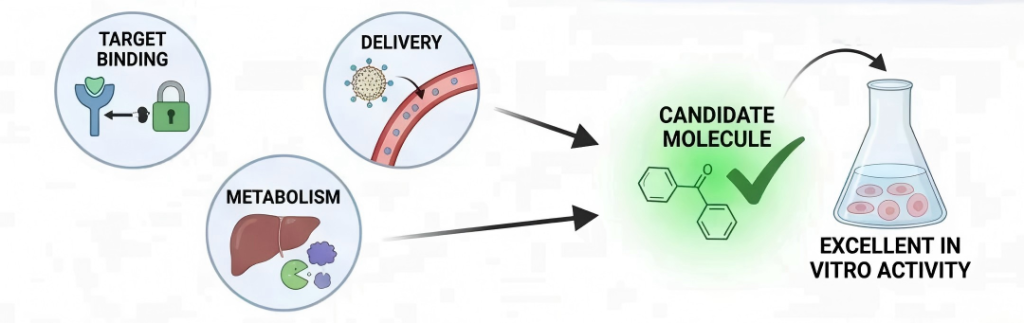
This is one of the central challenges of early drug development: the problem is not always whether an experiment can be performed, but which experiment should be performed first, what question it needs to answer, and what evidence is sufficient to support a Go/No-Go decision.
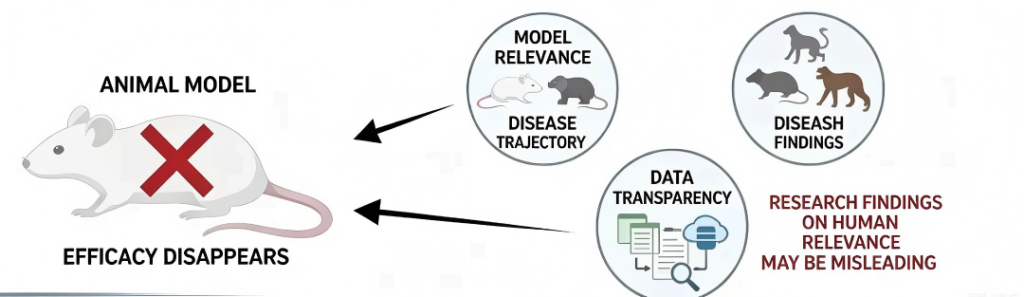
For biotech and pharmaceutical teams evaluating a preclinical CRO, technical capability alone is therefore not enough. A CRO should also be able to connect individual experiments into a coherent decision-making framework.
Below are seven questions worth asking.
1. Is the Molecule Engaging the Right Target?
A positive binding result does not automatically mean that a candidate is biologically effective. Early target validation should usually move through several levels:
- Pathway response: Are relevant downstream proteins, transcripts, signaling pathways, or phenotypes altered?
- Specificity: Is the observed effect target-dependent, or could it result from nonspecific toxicity?
Typical readouts may include proliferation, apoptosis, inflammatory markers, pathway proteins, mRNA expression, and cell-based functional assays.
For early-stage programs, the purpose is not simply to generate a positive assay result. It is to establish a mechanistic chain:
Target engagement → functional modulation → biological response
If that chain cannot be demonstrated, moving directly into expensive in vivo studies may create more uncertainty rather than reduce it.

2. Can the In Vitro Effect Translate In Vivo?
Strong in vitro activity does not guarantee efficacy in a disease model.
An in vivo proof-of-concept study should answer more than whether the treated group performed better than the control group. Depending on the program, important questions may include:
- Can efficacy be reproduced in a relevant oncology, inflammatory, metabolic, neurological, or other disease model?
- Is there a measurable change in tumor growth inhibition, disease score, biomarkers, or other disease-relevant endpoints?
- Does the drug reach the target tissue at a pharmacologically meaningful concentration?
- Is there a relationship between drug exposure and pharmacodynamic or efficacy response?
- Is there an identifiable dose-response relationship or therapeutic window?
The source article specifically emphasizes linking plasma exposure, target-tissue concentration, and efficacy endpoints on the same timeline, rather than interpreting efficacy independently from pharmacokinetics.
This is where integrated PK/PD and efficacy assessment becomes important.
An unsuccessful efficacy study may indicate several very different problems: insufficient exposure, poor delivery, rapid clearance, species differences, an unsuitable model, or lack of biological activity.
A useful preclinical program should help distinguish among them.

3. Does the Drug Actually Reach the Target Tissue?
This question becomes particularly important for nucleic acid therapeutics and delivery-dependent modalities.
A molecule may show very high transfection or knockdown efficiency in vitro while producing little or no effect in vivo if the delivery system fails to reach the relevant tissue.
Delivery assessment may therefore include:
- Biodistribution
- Target-organ exposure
- Cellular uptake
- In vivo stability
- Degradation kinetics
- Tissue accumulation
- Potential innate immune activation or inflammatory responses
For platforms such as LNPs, peptide carriers, and conjugated delivery systems, these measurements can help determine whether an apparent efficacy failure is actually a delivery failure.
The practical question is simple:
Can the drug get in, where does it go, and does enough of it reach the target to produce an effect?
This should ideally be addressed before large efficacy studies consume substantial quantities of test article.

4. Is the Candidate Developable from a DMPK Perspective?
Potency alone does not make a drug candidate developable.
A highly active molecule can still fail because of poor absorption, rapid clearance, excessive protein binding, unfavorable tissue distribution, or major species differences.
Early DMPK evaluation may examine:
- Metabolic stability
- Metabolite identification
- Plasma protein binding
- Permeability
- Tissue distribution
- Clearance
- Species differences
- Potential drug‒drug interaction risk
The original article argues against treating DMPK as a late-stage add-on after efficacy has already been established. Instead, pharmacokinetic and developability questions can be considered alongside early efficacy studies so that poor exposure or metabolic liabilities are identified before substantial resources are committed.
For CRO selection, this raises an important question:
Can the provider connect DMPK findings with efficacy data, or are these studies performed as isolated service modules?

5. Are Safety Risks Being Identified Early Enough?
Formal safety assessment occurs later in development, but obvious liabilities should not remain invisible until that stage.
Early screening can help identify signals that may influence candidate selection, dose selection, or molecular optimization.
Depending on the modality, early assessments may include:
- Cytotoxicity
- hERG-related cardiac risk
- Cytokine release
- Inflammatory responses
- Immunogenicity-related signals
The source article highlights the risk of relying on a single cell-viability assay as evidence that a candidate is “safe,” when other liabilities may remain undetected.
The goal of early screening is not to replace formal regulatory toxicology.
It is to answer an earlier development question:
Is there already enough evidence of risk to reconsider, redesign, or deprioritize this candidate?

6. Is the CRO Using a Modality-Appropriate Evaluation Strategy?
Not every therapeutic modality should be assessed using the same workflow.
This is particularly relevant for cell and gene therapy products.
For CAR-T, CAR-NK, viral-vector-based, and related programs, evaluation may need to cover several linked levels:
In vitro
- Viral packaging or vector-related performance
- Transduction efficiency
- Cell proliferation
- Cytotoxic activity
- Cytokine release
- Other functional assays
In vivo
- Cell persistence
- Tissue or tumor infiltration
- Antitumor activity
- Preliminary off-target or toxicity observations
The source specifically notes that CGT evaluation should extend beyond whether engineered cells kill tumor cells in culture to whether they survive, traffic to the relevant site, infiltrate tissue, and maintain functional activity in vivo.
A CRO with broad technical capabilities is useful. A CRO that understands how those capabilities must be adapted to different therapeutic modalities is more useful.

7. Can the Data Be Connected into a Decision-Making Evidence Chain?
Preclinical experiments generate many individual datasets: PK, efficacy, histopathology, IHC, biomarkers, bioanalysis, molecular assays, imaging, and sometimes multi-omics data.
The value does not come from producing these datasets independently. It comes from connecting them. Useful questions include:
- Does histopathology support the efficacy phenotype?
- Do biomarker changes correlate with drug exposure?
- Does target-tissue exposure explain the magnitude or duration of efficacy?
- Can PK and efficacy data explain why one dose works and another does not?
- Can the study package be organized consistently enough to support later-stage development?
The original article describes this as integrating histopathology, IHC, TEM, biomarkers, multi-omics, PK and efficacy data to help explain why a candidate works―or why it does not.
This is particularly important for early pilot and proof-of-concept studies, where the purpose is often not to produce the largest possible dataset, but to generate the smallest sufficiently informative dataset needed for the next development decision.

What to Look for When Selecting a Preclinical CRO
The seven questions above can be reduced to a practical CRO-selection framework:
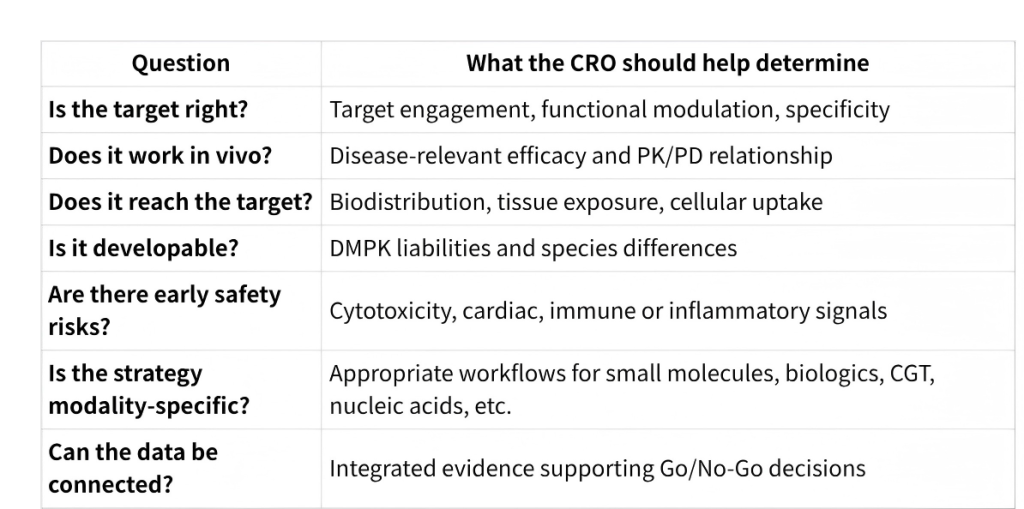
A preclinical CRO should therefore be evaluated not only by the number of assays or animal models it offers, but by whether it can help answer these questions in the correct sequence.
How Toprion Bio Supports Early Preclinical Development
Toprion Bio, the overseas business division of MD Pharma, supports early-stage drug development across mechanism studies, in vivo efficacy, PK/PD, bioanalysis, early DMPK, preliminary non-GLP safety assessment, pathology, molecular biology, and imaging.
With 600+ established animal models across major disease areas, projects can be designed around the biological question rather than forcing every program into a fixed study template.
For early Pilot and Proof-of-Concept studies, the focus is typically on resolving the key uncertainties before teams commit substantial time, compound, and budget to larger studies:
Does it engage the target? Does it reach the right tissue? Does it produce a meaningful biological effect? Is the exposure sufficient? Are there obvious development risks?
Early preclinical development is ultimately a sequence of investment decisions.
The earlier the critical uncertainties are resolved, the easier it becomes to decide what should move forward, what needs optimization, and what should stop.